COMPASS Newsletter #2
We are excited to share the second COMPASS Newsletter, designed to update you on the progress and results of our project activities, along with other significant developments in the field

We are excited to share the second COMPASS Newsletter, designed to update you on the progress and results of our project activities, along with other significant developments in the field

Extreme event attribution (EEA) studies have become a critical tool for understanding how climate change influences the likelihood and severity of extreme weather events. However, most studies to date have

The COMPASS project recently released a gridded dataset of global exposure (population, gross domestic product and net fixed asset value) at a spatial resolution of 30 arc seconds (≈0.93 km

The Potsdam Institute for Climate Impact Research (PIK) hosted the 2nd General Assembly of the COMPASS project, which took place on 12th and 13th of February 2025, in Potsdam Germany.

On 11 February 2025, the 2nd COMPASS workshop on impact attribution of disasters took place at the Potsdam Institute for Climate Impact Research (PIK). The event was filled with engaging

This work is part of the work package WP5 “Demonstrator with steps towards an operational deployment” of the COMPASS project, whose overarching objective is to characterize compound extremes in current

There are currently many well-established climate attribution methodologies for single driver extremes, however, there is very little literature on more complex extremes such as compound, sequences and cascading hazard events.

Tropical cyclone-induced storm surge is a major coastal risk, which will be further amplified by rising sea levels under global warming. Here, a computational framework is presented, globally applicable modeling

The COMPASS project recently released a report on “Dataset of tropical cyclone-affected areas”. The overarching goal of the COMPASS project is to develop a harmonised methodological framework for climate and

This Policy Brief highlights the critical need to address the complex and compounding impacts of climate extremes, driven by climate change and non-climate factors, to ensure effective disaster risk management

The COMPASS project recently prepared a “Report on dataset on best-available methods and climate datasets“. There are currently many well-established climate attribution methodologies for single driver extremes, however, there is

In October, Doris Vertegaal, Researcher at Deltares and member of COMPASS team, visited the Potsdam Institute for Climate Impact Research (PIK) in Germany. During her stay, among several other activities,

We are excited to share the first COMPASS Newsletter, designed to update you on the progress and results of our project activities, along with other significant developments in the field of

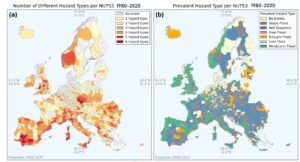
HANZE (Historical Analysis of Natural HaZards in Europe) database was initiated in 2016 by Dominik Paprotny (COMPASS project partner) while working on pan-European flood hazard mapping at Delft University of

The COMPASS project recently released a set of “Guidelines for compound extremes modelling in current and future climates”. Compound extremes have complex spatiotemporal dynamics that must be accurately captured to
Be the first to know about our latest news and updates, by signing up for our newsletter. We value your privacy and promise to handle your email with care. As a subscriber, you’ll receive exclusive content and helpful resources delivered right to your inbox. Rest assured that we will never sell or abuse your email address.
COMPASS aims to develop a harmonised, yet flexible, methodological framework for climate and impact attribution of various complex extremes that includes compound, sequences and cascading hazard events
The COMPASS project has received funding from the European Union’s HORIZON Research and Innovation Actions Programme under Grant Agreement No. 101135481
Funded by the European Union. Views and opinions expressed are however those of the author(s) only and do not necessarily reflect those of the European Union or of the European Health and Digital Executive Agency (HaDEA). Neither the European Union nor the granting authority can be held responsible for them.