The COMPASS project recently released a report on “Hazard and Impact Synthesis and Attribution for Phase I use case“.
This document provides an in-depth summary of the implementation, strengths, and challenges of the first phase of COMPASS Use Cases (UCs). The overarching goal of COMPASS is to develop a harmonized and flexible methodological framework for attributing climate and impact to complex extreme events, including compound, sequential, and cascading hazards such as storm surge and river flooding, or sequences of tropical cyclones. The UCs served as critical test beds for evaluating this framework, encompassing a diverse range of event types and geographical contexts. Two primary attribution analysis methods, probabilistic (risk-based) and storyline-based, were implemented, each offering distinct advantages in analysis and communicating results to stakeholders. This report details the observed hazards, impacts, modeling frameworks, and attribution results for each UC, concluding with a synthesis of key findings and avenues for future advancement through the phase to UCs.
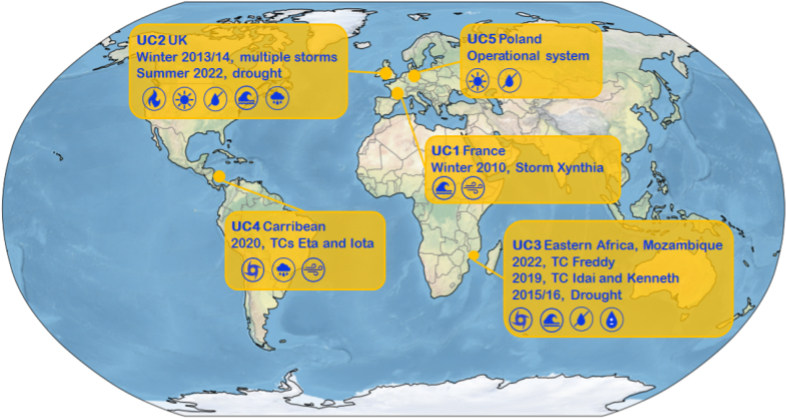
In many of the use cases, climate change emerged as a significant driver of the observed and recorded impacts of the compounding hazards. At the same time, non-climate drivers including population and economic growth, the covid-19 pandemic, and chronic insecurity and poverty emerged as critical factors, highlighting the need to consider the wider complexity of extreme events and the holistic policy responses required to reduce the impacts of future extremes.
The UCs have demonstrated the value of a harmonized but flexible methodological framework, allowing implementation to adapt to local contexts and data availability, but still benefiting from considerable shared code, model components, and datasets. This success clearly suggests that the goal of operational attribution modeling is achievable. Moving forward several opportunities have emerged related to the further refinement and development of the COMPASS methodological framework including improved bias correction of climate datasets, improved inclusion of mitigation measures such as flood defenses in the relevant models, improved inclusion of quantitative vulnerability indicators, and further integration of quantitative and qualitative attribution approaches. With the initial methodological framework well established, an increased focus on stakeholder engagement and policy relevance is now possible.
The report is also available on Zenodo: 10.5281/zenodo.17099072
More information can be found in the following COMPASS project Deliverable:
Jack, C., Vogel, M., de Boer, T., Gale, S., Paprotny, D., Muis, S., Goulart, H., Wilson, E., Munday, G., Cotterill, D. (2025): Hazard and Impact Synthesis and Attribution for Phase I use case. Horizon Europe project COMPASS. Deliverable D4.1.