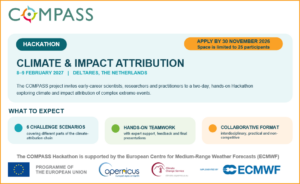


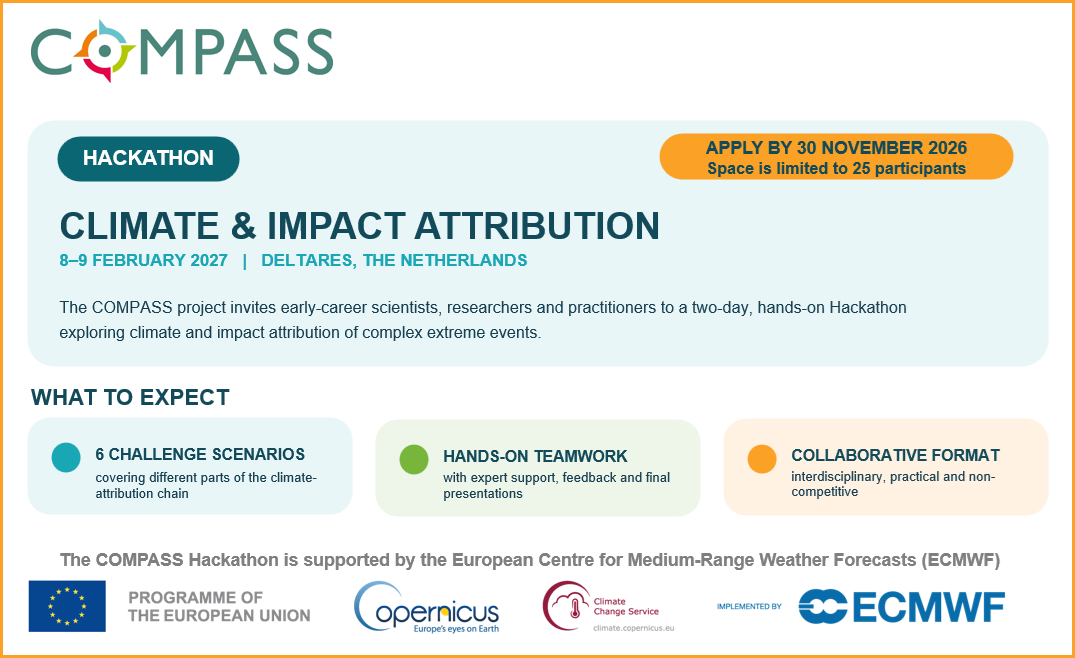
The COMPASS project invites early-career scientists, researchers and practitioners to join a two-day, hands-on Hackathon exploring climate and impact attribution of complex extreme events. The Hackathon is supported by the European Centre for Medium-Range Weather Forecasts (ECMWF).
Around 20–25 participants will work in small interdisciplinary teams on six challenge scenarios using methods, datasets, modelling outputs and tools developed within COMPASS. The challenges cover different parts of the attribution chain — from developing counterfactual climate conditions and examining modelling choices to impact attribution, causal mapping, data visualisation and communicating attribution results.
1. Generating counterfactual climate time series with ATTRICI
Explore how different methodological choices affect the generation of factual and counterfactual climate time series using the ATTRICI Python packag
2. How does data resolution affect attribution results? — Somerset Levels floods
Investigate how different spatial resolutions of precipitation and elevation data influence flood-impact attribution results.
3. Advancing impact attribution for Tropical Cyclone Idai in Mozambique
Explore new approaches to impact attribution, including exposure and vulnerability, alternative impact metrics, communication and visualisation, and comparison of attribution approaches.
4. Climate Attribution Story Generator with EarthKit
Transform factual and counterfactual climate and impact datasets into clear, reproducible and evidence-based attribution stories using EarthKit.
5. Causal Mapping and Qualitative Counterfactuals
Use causal mapping to examine how hazards, exposure, vulnerability, preparedness and response contributed to the impacts of Tropical Cyclones Eta and Iota in Honduras, and explore qualitative counterfactual scenarios.
6. Beyond climate: disentangling the drivers of water scarcity in Crete
Explore how climate change, land-use change and water-demand changes have contributed to water scarcity in the Tympaki basin, and develop an interactive prototype for exploring factual and counterfactual scenarios.
Participants will work in teams of 4–5, supported throughout the Hackathon by COMPASS researchers and technical experts. The Hackathon is collaborative rather than competitive, with opportunities to test methods, exchange ideas across disciplines and present results to an expert panel.
We particularly encourage applications from early-career scientists, although applications from other researchers and practitioners are also welcome. Relevant backgrounds include climate and impact attribution, climate-data analysis, hazard and impact modelling, hydrology, compound extremes, programming, data visualisation, causal analysis and science communication. You do not need expertise in all these areas — teams will be formed to bring together complementary skills.
The Hackathon offers a hands-on opportunity to work with COMPASS methods, datasets and attribution workflows while gaining practical experience in climate and impact attribution. You will also collaborate across disciplines, exchange ideas, connect and network with COMPASS experts and researchers working on different climate hazards and Use Cases
When registering, you will be asked to indicate your first and second preferred challenge scenarios and provide information on their skills and background to support team formation.
📅 Dates: 8–9 February 2027
📍 Location: Deltares, the Netherlands
👥 Participants: Approximately 20–25
📝 Application deadline: 30 November 2026
🧳 Costs: Participants cover their own travel and accommodation. Food during the Hackathon will be provided.
For full details about the Hackathon, the six challenge scenarios, expected activities and outputs, useful background and practical information, please download the full Call for Participants.